Breaking News or Background Briefing: Choose the Format for the Question
Breaking news or background briefing: learn which format answers what changed, what is known, and why a developing story matters to you.
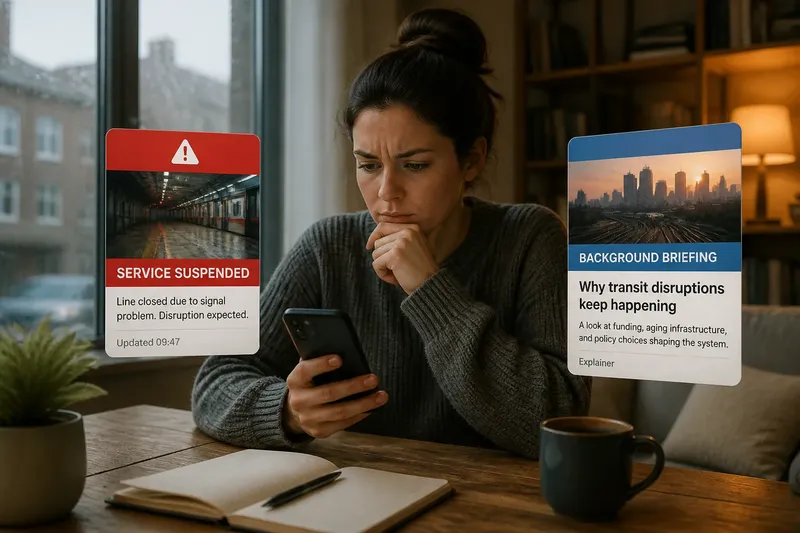
Your phone lights up with an alert about a transit shutdown just as you are deciding whether to leave home. A breaking update may tell you the line is closed; a background briefing may explain why the service keeps faltering and what the shutdown means for the rest of the network. Choosing between breaking news or a background briefing starts with the question you need answered.
What question does breaking news answer?
Breaking news is built to report a change that is happening now or has just become known. Its central question is usually simple: what happened, where, and what is known so far? A brief update can also say what remains unclear or what officials and witnesses have reported.
That format is useful when the situation itself may affect an immediate decision. A road closure, a court ruling, a severe-weather warning, or an election result can make the latest verified development more useful than a long explanation of the subject’s history.
The trade-off is that an early account is necessarily limited. Reporters and editors may still be checking details, seeking responses, or learning how an event unfolded. A careful update marks those limits rather than filling them with confident guesses.
Breaking coverage also changes as new information arrives. An article may be updated in place, with the newest detail near the top, while earlier passages remain below. Check the timestamp and look for wording that distinguishes confirmed information from preliminary reports; a familiar headline can survive after the story beneath it has changed.
What does a background briefing add?
A background briefing is designed to make an event or issue intelligible beyond its latest turn. It answers questions such as: What led to this? Which institutions or rules matter? What choices are still open? It may draw on earlier reporting, documents, expert explanation, and a timeline of relevant developments.
Background does not mean timeless, and it does not mean opinion. A useful explainer separates established context from a reporter’s interpretation, identifies the people or institutions involved, and shows how the present event connects to earlier decisions. Its value lies in giving a reader enough structure to understand why a new detail matters.
It can also help with a story that has no single dramatic moment. A policy dispute, a labor negotiation, or a long-running public-service problem may be hard to understand through isolated alerts. An explainer can lay out the competing positions and the process that might resolve them, without pretending that every uncertainty has disappeared.
How do you match the format to your question?
Start by putting your question into plain language. If it begins with “What just happened?” or “Is this still happening?”, look for a current update. If it begins with “Why?” or “How did this reach this point?”, a background piece is more likely to help.
- For an immediate change: Read the latest update and check its time stamp, location, and account of what is confirmed.
- For a decision affected by current conditions: Look for practical details in a live update, then check whether the publisher points to an official notice or service page.
- For causes or process: Choose an explainer that gives a timeline, names the relevant institutions, and distinguishes what is known from what is still contested.
- For consequences: Seek a piece that explains who may be affected, through what mechanism, and over what process—not merely one that predicts an outcome.
Say a reader sees an alert that a city council has paused a housing proposal. The immediate update can establish that the pause occurred and what the council said would happen next; the reader’s next question may be why the proposal was paused and which residents it affects. An explanatory briefing can supply that context, while the update remains the better source for any later vote or revised schedule.
The two formats are often most useful in sequence, not as rivals. Read the update to establish the current state, then use background coverage to understand the machinery behind it. If the briefing is older, return to current reporting before relying on it for the latest status.
How should you read updates and explainers?
Format can shape what a story emphasizes. An update’s opening tends to prioritize the newest development; background coverage may lead with the larger pattern or the question it is trying to explain. Neither opening, by itself, tells you whether the rest of the piece answers your particular concern.
For an update, inspect the sequence of changes. Does the article say what was newly confirmed? Does it label information that comes from an early account? If the page provides an update note, use it to see whether a major detail has been added, corrected, or clarified. A rapidly changing story may contain several layers of certainty at once.
For a briefing, inspect the boundaries of its explanation. Is the timeline clear? Does the piece identify which parts are established and which remain disputed? Does it explain relevant terms and procedures rather than treating them as obvious? A background story that answers “why” should show the connecting logic, not merely arrange facts beside one another.
Also notice whether a piece tells you what it cannot answer. A briefing may explain the rules but not predict how decision-makers will use them. An update may confirm that an event occurred without yet establishing its cause. Those limits are useful information: they help you avoid asking one format to do the work of another.
Which format fits common reader questions?
Where can I find the latest confirmed development?
Choose a current update, and check its timestamp and the wording around new details. If the event is unfolding, treat the account as provisional where the article itself says facts remain under review.
Why did this issue become a story now?
Look for a briefing that connects the immediate trigger to the relevant history, rules, or decisions. A useful explanation makes clear which earlier facts are needed to understand the present moment and which are simply extra scenery.
What should I understand before sharing this story?
First establish what the update actually confirms; then consult background coverage if a missing cause or process could change how the event is understood. Share the article that supports the claim you intend to make, rather than relying on a headline alone.
Will this explain what happens next?
An update may report an announced next step, while a briefing can explain the procedure and the choices that remain. Neither format can turn an unsettled process into a settled outcome, so distinguish a scheduled action from a prediction.
When is one format not enough?
Some questions have two parts: “What changed?” and “What does that change mean?” A short update can answer the first while leaving the second open; a background briefing can answer the second while becoming out of date on the first. Reading both can be sensible, provided you keep their different jobs in view.
For example, a briefing about a proposed change to school admissions may describe the existing rules and the debate around them. If a district later revises its proposal, the background piece may still explain the debate but no longer describe the current proposal accurately. Pair it with a fresh update, and check the publication’s correction or update notes if the distinction matters.
When you search, include the question as well as the subject: terms such as “latest update,” “explainer,” “timeline,” or “how the process works” can help surface the format you need. These labels are clues, not promises; read the opening and structure to see whether the article actually answers the question.
Breaking news or background briefing is a useful distinction because it helps you choose the right kind of answer, not because every story fits neatly into one box. Ask whether you need the current state, the explanation behind it, or both. That small pause can prevent an old explainer from standing in for the latest report—and an urgent alert from being mistaken for the whole story.