Before the Byline: How News Desks Took Shape
News desk history helps readers see how assigning, editing, and preparing copy shape a story before publication, even when one editor handles every task.
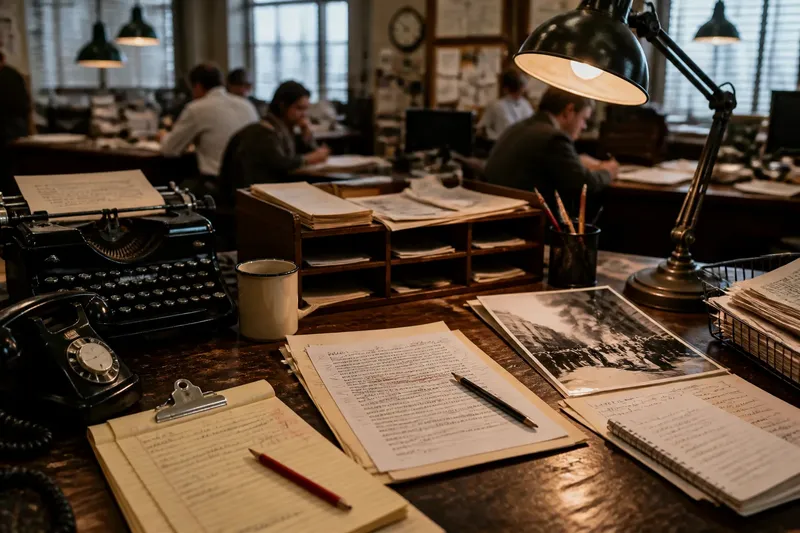
A reporter’s dispatch once arrived at a newspaper office by telephone, handwritten pages, or typewriter, then passed through several hands before reaching readers. News desk history is, in broad terms, the story of how newspapers organized those handoffs—not a single invention with one agreed starting date.
The details varied across publications and periods. The useful point is narrower: as newspapers handled more incoming material, they developed ways to assign coverage, edit copy, and prepare it for publication. A small newsroom might combine these jobs; a larger one might divide them among several people.
Why did news desks take shape?
In small newspaper operations, editors could work closely with printers and contributors. As a paper’s coverage and output grew, someone had to track submissions, select material for an edition, and coordinate its passage toward publication.
“Desk” came to describe this editorial function as well as a physical workspace. It could include sorting news, directing reporters, editing copy, and communicating with the people preparing pages. The specific organization differed from one publication to another, so the history is better understood as a gradual division of work than as a universal sequence.
New communication and production tools changed the mechanics. Telegraphs carried dispatches over distance, telephones let editors speak with reporters, and typewriters made copy easier to revise than handwritten pages. These tools affected how material arrived and moved; they did not remove the need to choose, clarify, and prepare it.
Imagine a local editor receiving a short report about a factory fire and a longer account of a town meeting. The editor asks a reporter to confirm the fire’s basic details, requests a clearer account of the meeting’s decision, and allocates room for both. The result is two distinct pieces of coverage, with separate questions and reporting needs.
What did assigning add to reporting?
An assignment made coverage a planned newsroom task rather than a matter of waiting for material to arrive. An editor could direct a reporter toward a question, place, meeting, or public record and explain what the story needed to establish.
The assignment was not the story itself. A useful assignment named a subject and a reason to pursue it while leaving room for what reporting might reveal. An editor might ask for a clear account of a council decision without prescribing whether that decision was wise.
Assignments also helped editors see which subjects were covered, which needed follow-up, and where reporters’ work overlapped. As some newspapers organized coverage around beats or editions, that overview could help coordinate work. The arrangements were not identical everywhere.
Readers can sometimes see an assignment’s boundaries in a story’s focus. A report centered on a public meeting may explain what was decided and who is affected, while leaving broader policy history to another piece. That limit may reflect the question being pursued and the reporting available, rather than a claim that the larger context does not matter.
How did editing become a distinct craft?
Editing involved more than correcting spelling. Editors worked to make copy intelligible, check whether claims were supported by the material at hand, remove confusion, and guide readers through the story. Good editing also preserves uncertainty when the reporting has not settled a question.
Print production added practical demands. Editors prepared copy for typesetting, marked revisions, adjusted text to available space, and wrote or revised headlines. Those tasks involved judgment as well as mechanics: what to foreground, what to cut, and how to describe the piece.
Copy editors became associated with line-level clarity and consistency. They might flag an unclear reference, a headline that overstated the story, or a sentence that claimed more than its evidence supported. They also applied house style so a publication’s spelling, capitalization, and usage remained consistent across writers.
Editing is not a neutral passage from rough to polished. Cutting repetition can also remove context. A headline can make a story easier to grasp while emphasizing something different from the reporter’s main point. The editorial task is to improve clarity without changing what the reporting establishes.
What happens between edited copy and publication?
Preparing a story connected editorial decisions to the form readers encountered. In print, text had to work with column space, type, photographs, captions, and deadlines. Editors and production staff also needed to track revisions so the version placed on a page reflected the intended changes.
Page editors and layout staff helped determine a story’s placement and space. Placement can signal prominence; a photograph or caption can add context, but readers may mistake it for the story’s central point. Presentation is part of publication, not decoration added after all editorial decisions are finished.
Digital publishing can involve posting, updating, retitling, and displaying a story on different screens. The order of work may differ from print, but familiar functions remain: someone commissions or assigns the reporting, someone edits it, and someone prepares its presentation and release. In a small outlet, one person may handle all of these tasks.
How can readers spot the news desk’s work?
A byline identifies authorship, but it does not show every editorial hand involved. Readers can look for clues about scope, presentation, and revision without assuming that every sentence came directly from the named reporter.
- Check the story’s stated question. If the opening identifies a narrow question, then read the story within that scope; if it leaves the question unclear, look for the purpose explained in later paragraphs.
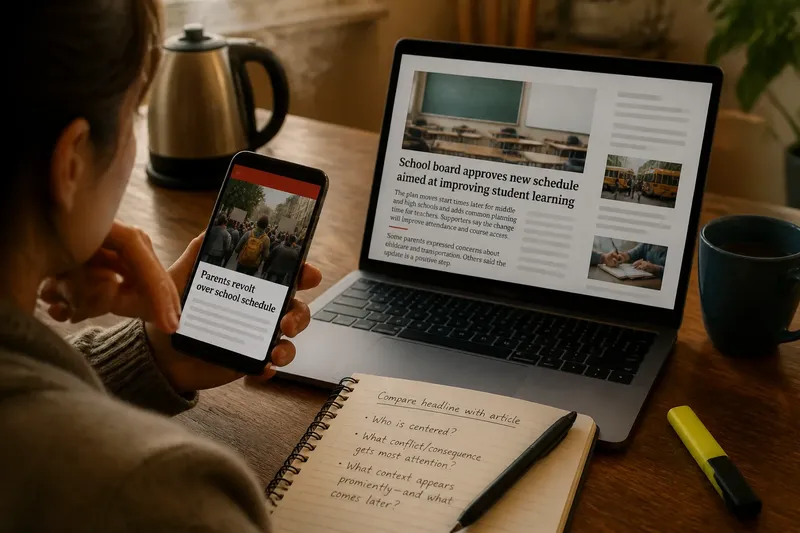
- Compare the headline with the article. If the headline matches the body’s claim and certainty, treat it as a concise description; if it sounds stronger, rely on the article’s supported wording instead.
- Look for an update or correction note. If a note explains what changed, use it to understand the current version; if no note appears, do not assume the story has never been revised.
- Read captions and sidebars separately. If they add context consistent with the article, consider them alongside it; if they introduce a claim or emphasis not explained in the body, keep that distinction in view.
- Check staff and contact information. If the publication names editors or desks, use that information to understand its visible structure; if it lists only a few staff members, do not infer that no others contributed.
- Notice whether the story names its limits. If it says what remains unknown or outside its scope, use those limits when judging its claims; if it does not, avoid treating silence as proof that a question was settled.
These clues cannot reveal every internal decision, but they help separate reporting from the editorial work that shapes its presentation. A published story is both an account of events and a prepared object, made through choices at more than one stage.
What do readers ask about news desk history?
Is a news desk the same as an editor?
No. A desk is a newsroom function or team, while an editor is a person with particular responsibilities. One editor may run a desk, or several editors may share its work.
Does every story pass through a copy desk?
No. Workflows differ by newsroom. A small publication may have one person assign, edit, and prepare a story, while a larger outlet may divide those duties among assigning editors, line editors, copy editors, and production staff.
Can an editor change a reporter’s meaning?
Editors can reshape wording, structure, and emphasis, which makes the difference between clarification and alteration important. A substantial change that could affect a claim’s meaning may call for checking with the reporter, depending on the newsroom’s process.
Why might a headline differ from the article’s wording?
A headline has limited space and may be written by someone other than the reporter. Read the article to judge whether the headline’s emphasis and certainty match what the reporting supports.
Why does news desk history still matter?
News desk history helps explain why assigning, editing, and preparing copy are distinct functions, even when one person performs them all. Assigning defines what a newsroom asks someone to report; editing makes the resulting material clear; preparation shapes how readers encounter it. The boundaries shift with staffing and technology, but the distinctions remain useful.
When reading a story, treat its byline as one part of its production history, not a complete account. Look at the story’s stated scope, the relationship between headline and evidence, and any visible revision notes. That gives you a more precise question than simply asking who wrote it: what editorial work shaped the version you are reading?